Baking Bliss and Hilarious Mishaps: My Journey with Cincinnati Coffee Bread
Welcome back to the blog, fellow baking enthusiasts and those who appreciate a good laugh at a baker’s expense! Today, our kitchen saga could easily be titled “365 Days of Baking: Lynne’s Culinary Catastrophes.” It was, without a doubt, one of *those* mornings. I woke up battling a formidable headache, and I’m wholeheartedly blaming the subsequent kitchen chaos on the powerful dose of caffeine in my Excedrin. Good grief, what an adventure it turned out to be!
The recipe, the seemingly simple guide to Cincinnati Coffee Bread, began innocently enough: “Mix the milk, sugar, butter, and salt in a large bowl and cool to lukewarm.” Sounds straightforward, doesn’t it? Well, it is, until your kitchen transforms into an accidental abstract art canvas of dairy and sugar. I still ponder how a mere 1 cup of milk, 1/3 cup sugar, 5 tablespoons butter, and 1 teaspoon of salt could achieve such widespread distribution across my entire kitchen. Such few ingredients, yet so much potential for disaster. My mind was clearly elsewhere.
The Great Kitchen Fiasco: A Butter-Flying Tale
My first attempt at this seemingly humble recipe began with heating the milk on the stove. Simultaneously, I placed the other ingredients into my trusty KitchenAid mixer. In retrospect, the fact that the butter was still a solid, unyielding chunk in the bowl should have been my very first clue that things were about to go south. But alas, I proceeded. I poured the heated milk into the mixer bowl, confidently flicked the switch, and plunged straight into a dairy-based catastrophe.
It was far from a pretty sight. Milk, in all its creamy glory, began to fly. Chunks of solid butter, now propelled by the mixer’s rotor, became airborne projectiles, darting across the kitchen. My poor cat, an innocent bystander, received a surprise spattering and promptly bolted for cover. Droplets of milk, dissolved sugar, tiny salt crystals, and semi-melted butter created a mosaic across the floor, the kitchen table, the mixer itself, the countertops, and, of course, me. I was a sticky, buttery mess, and my aspirations for a peaceful baking morning were rapidly disintegrating.
In a moment of pure panic and what can only be labeled as my second “brain fart” of the day, I lunged for the mixer’s off switch. Predictably, my hand found the speed dial instead, pushing it in the wrong direction and ramping the mixer up to an even higher velocity. OH! MY! GOSH! The chaos escalated. While I often appreciate the lessons learned from mistakes, I find it incredibly difficult to embrace them when they result in such a profound, physical mess that demands extensive cleanup. At that point, it tipped from frustration into sheer comedy.
A Second Chance and a Minor Flour Flood
After a deep breath and a good laugh at my own expense, I decided to start from scratch. This time, armed with the wisdom of my previous failure, I melted the butter directly with the milk while it was heating. Then, with newfound caution, I mixed everything together with a simple spoon. *Much* better, and thankfully, far less dramatic. Peace returned to my kitchen, albeit temporarily. Just as I was feeling a sense of triumph, I went to add the flour and, in another clumsy moment, managed to drop the bowl containing the dry ingredients directly into the liquid mixture. It landed with a dull thud, creating yet another, albeit smaller and less explosive, mess to clean up. It truly felt as if the baking gods were conspiring against me that morning. But perseverance, as they say, is key. The batter is now rising gracefully in the oven, and I’m cautiously optimistic about what comes next. I fully anticipate finding greasy spots all over my kitchen for the next few days – a greasy, buttery souvenir of my baking escapades.
A Moment of Levity: My Mischievous Husband
UGH! Just as I was recovering from my kitchen ordeal, my husband, who had been out for a run when all the butter-flying madness unfolded, decided to mess with my head. I’m currently typing this on his laptop, and he had strategically placed his remote mouse on the counter. While pretending to simply dry his hands on a towel, he was stealthily using the mouse to move the cursor and scroll the page up and down. It genuinely freaked me out! My hands were resting innocently in my lap, yet the screen was still moving all over the place. What a meanie! It’s a good thing that after more than 20 years, I still find his antics incredibly humorous. I wouldn’t trade him for anything, despite his occasional mischievous streaks.
Discovering the Delight of Cincinnati Coffee Bread
My quest for the perfect Cincinnati Coffee Bread led me to its delightful origins in my cherished *Fannie Farmer Cookbook Thirteenth Edition*, specifically on page 523. This classic recipe, authored by Marion Cunningham, was published by Alfred A. Knopf, Inc., a division of Random House (ISBN 0-394-56788-9). This beloved cookbook is a treasure trove of traditional recipes, and I was eager to experience this regional classic for myself.
Cincinnati Coffee Bread: The Recipe
This recipe yields a wonderfully aromatic and comforting coffee bread, perfect for breakfast or an afternoon treat. The combination of tender yeast bread with a sweet, spiced filling creates a truly memorable experience.
Ingredients for the Bread:
- 1 cup hot milk
- 1/3 cup granulated sugar
- 5 tablespoons unsalted butter
- 1 teaspoon salt
- 1 package (approximately 2¼ teaspoons) active dry yeast
- ¼ cup warm water (around 105-115ºF or 40-46ºC)
- 2 large eggs, well beaten
- 4 cups all-purpose white flour
Ingredients for the Filling:
- 1 cup bread crumbs (panko or fine fresh bread crumbs work best)
- 3 tablespoons granulated sugar
- 1 tablespoon ground cinnamon
- 4 tablespoons unsalted butter, melted
Step-by-Step Baking Instructions:
Step 1: Prepare the Base Mixture
In a large mixing bowl, combine the hot milk, 1/3 cup sugar, 5 tablespoons butter (ensuring it’s melted for a smoother start!), and the salt. Stir thoroughly until the sugar and salt are dissolved, and the butter is fully incorporated. Allow this mixture to cool to lukewarm temperature (around 105-115ºF or 40-46ºC). It’s crucial not to let it get too hot, as this can kill the yeast in the next step.
Step 2: Activate the Yeast
While the milk mixture is cooling, gently stir the package of active dry yeast into the ¼ cup of warm water. Let this mixture stand undisturbed for about 5 minutes. You’ll notice the yeast starting to foam and bloom, indicating that it’s active and ready to work its magic. This activation process ensures your bread will rise properly.
Step 3: Combine and Beat
Once the milk mixture is lukewarm and the yeast is activated, add the dissolved yeast mixture, the two well-beaten eggs, and the 4 cups of white flour to the large bowl containing the milk mixture. Beat all the ingredients together very well. You can use a stand mixer with a dough hook on medium speed, or a sturdy spoon and some elbow grease. The goal is to develop the gluten in the flour, which will give the bread its structure. Beat until the dough is smooth and elastic.
Step 4: First Rise
Cover the bowl loosely with plastic wrap or a clean kitchen towel. Place it in a warm, draft-free spot in your kitchen. Allow the dough to rise until it has doubled in bulk. This typically takes anywhere from 1 to 1.5 hours, depending on the warmth of your environment. This first rise is essential for developing flavor and texture in the bread.
Step 5: Prepare for Baking
Once the dough has doubled, gently stir it down with a spoon to release some of the air. Beat it thoroughly once more. Lightly butter or grease a standard loaf pan. Spoon the dough into the prepared loaf pan.
Step 6: Create and Incorporate the Filling
In a separate small bowl, combine all the filling ingredients: bread crumbs, 3 tablespoons sugar, 1 tablespoon cinnamon, and the 4 tablespoons of melted butter. Mix these thoroughly until the bread crumbs are evenly coated and moist. As for incorporating the filling into the batter, the original recipe suggests “just barely swirling the filling through.” However, based on my experience, where the batter was quite thick and more like dough, I found it more effective to gently poke the filling into the dough with a spoon, or even try to lightly fold it in. The goal is to distribute the filling somewhat, without completely integrating it into the dough. This creates lovely pockets of spiced sweetness.
Step 7: Second Rise
Cover the loaf pan again with plastic wrap or a clean kitchen towel. Let the dough rise a second time until it has doubled in bulk once more. This second rise, often called the proofing stage, will make your bread light and airy. Keep an eye on it – it might rise faster this time.
Step 8: Bake to Golden Perfection
While your bread is undergoing its second rise, preheat your oven to 350ºF (175ºC). Once the bread has doubled, place the loaf pan in the preheated oven. Bake for approximately 40-50 minutes, or until the bread is golden brown on top and sounds hollow when tapped on the bottom. To prevent the filling from spilling over (a common issue!), you might want to place a cookie sheet on the rack below the loaf pan to catch any drips.
Step 9: Cool and Enjoy
Once baked, carefully remove the bread from the oven. Let it cool in the pan for a few minutes before carefully turning it out onto a wire rack to cool completely. Allowing it to cool fully will prevent it from becoming soggy and helps set the internal structure.
My Honest Review: The Cincinnati Coffee Bread Experience
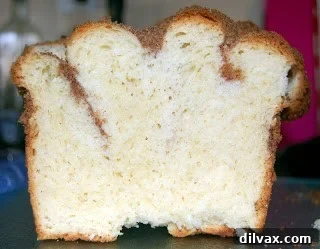
Upon reviewing the recipe again, I had initially imagined a batter that was truly “spoonable” after the first rising, allowing for a gentle swirl of the filling. However, my experience was quite different. The consistency of the mixture after the first rise was definitely more akin to a thick, soft dough rather than a pourable batter. This meant that my attempt to “swirl” the filling was, in reality, more like carefully poking and pressing it into the dough with a spoon. It’s an important distinction for anyone attempting this recipe: prepare for a dough, not a batter!
During the baking process, I was quite interested to see how the bread would turn out, especially with the filling that seemed to largely sit on top. True to my prediction, much of the cinnamon-sugar-bread crumb mixture did indeed remain on the surface, creating more of a delectable topping than an integrated filling. I highly recommend placing a cookie sheet underneath the loaf pan to catch any overflow, as the filling can easily spill out and burn on the bottom of your oven.
Now for the taste test. The bread itself tasted good – it was pleasantly sweet, but not overwhelmingly so, making it suitable for breakfast. The texture was soft and tender. The filling, while delicious, was undeniably more of a topping. The portions I managed to “poke” into the batter didn’t really spread or integrate as I had hoped. This left some sections of the bread wonderfully spiced and sweet, while others were simply plain. Cutting the bread also proved to be a bit of a challenge; the cinnamon, sugar, and bread crumb topping tended to scatter everywhere, creating a delightful mess on the counter with every slice.
Overall, as far as homemade breads go, it’s an enjoyable loaf. It’s a comforting bake, especially given its traditional roots. However, I don’t anticipate us devouring the entire loaf immediately. Perhaps a slice, lightly toasted tomorrow morning with a fresh cup of coffee, will be its true moment to shine. My personal rating for the Cincinnati Coffee Bread, on a scale of 1-4 with 4 being the absolute best, is 2½ rolling pins. It’s a solid, rustic bread with a lovely flavor profile, but the filling integration could use some refinement for a truly exceptional experience. Perhaps next time, I’ll try spreading half the dough in the pan, scattering the filling, and then topping with the remaining dough for better distribution.
Tips for Your Own Cincinnati Coffee Bread Journey:
- Melt Your Butter! Learn from my initial mistake. Ensure all butter is melted and incorporated smoothly into the warm milk mixture before adding other ingredients to avoid messy surprises.
- Mind the Temperature: Always ensure your liquid mixture is lukewarm (not hot!) before adding yeast to prevent killing the yeast and impacting your rise.
- Embrace the Dough: Don’t be surprised if your mixture after the first rise is more like a soft dough than a liquid batter. Adjust your expectations for incorporating the filling accordingly.
- Filling Integration: For a more integrated filling, consider dividing your dough in half, spreading one half in the pan, sprinkling the filling, and then topping with the second half of the dough. Or, try rolling the dough out, spreading the filling, and then rolling it into a log before placing it in the pan.
- Baking Sheet for Drips: Always place a baking sheet on the rack below your loaf pan to catch any potential drips from the filling, saving you from a burnt mess in your oven.
- Serving Suggestion: This bread is delightful on its own, but truly shines when toasted and served with a pat of butter or a smear of cream cheese, alongside a warm cup of coffee or tea.
Happy baking, everyone! May your kitchens be less chaotic and your coffee bread perfectly delicious.