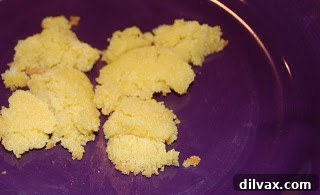
A Culinary Curiosity: Unraveling the Enigmatic Corn Crisps from the Fannie Farmer Cookbook
Every culinary adventure, whether a grand feast or a simple snack, holds the promise of discovery. Sometimes, this journey leads to delicious triumphs, and other times, to intriguing, even “bizarre,” revelations. Today, my kitchen became the stage for the latter. Armed with a beloved classic cookbook, I embarked on what I thought would be a straightforward baking experiment, only to discover a recipe that truly challenged my palate and expectations. It was a stark reminder that even the most reputable culinary guides can occasionally present a dish that stands uniquely apart from the delicious norm. This particular creation, the “Corn Crisps,” left me pondering the boundaries of snackology and the diverse interpretations of “crisp.”
My kitchen explorations often lead me back to tried-and-true sources, and the Fannie Farmer Cookbook is undeniably one of them. It’s a culinary institution, a tome of traditional American cooking that has graced countless kitchens for generations. Yet, within its esteemed pages, I encountered a recipe that simply didn’t resonate, failing to deliver the comforting flavors or satisfying textures I’ve come to associate with cornmeal. This particular entry, which I’ll delve into shortly, proved to be an unexpected detour on my gastronomic journey, a dish that will likely be remembered more for its peculiarity than its palate-pleasing qualities.
Unearthing a Classic: The Enduring Legacy of the Fannie Farmer Cookbook
The recipe for these enigmatic “Corn Crisps” is sourced from a culinary cornerstone: the Fannie Farmer Cookbook, Thirteenth Edition. Penned by the venerable Marion Cunningham, and published by Alfred A. Knopf, Inc., a division of Random House (ISBN 0-394-56788-9), this cookbook represents a significant piece of American culinary history. The original Fannie Farmer Cook Book, first published in 1896, revolutionized home cooking by introducing standardized measurements, earning it the moniker “the mother of level measurements.” Marion Cunningham, through her meticulous revisions, ensured that the cookbook remained relevant and beloved for contemporary cooks, bridging the gap between historical culinary practices and modern kitchen needs. Her editions are celebrated for preserving the essence of traditional American recipes while making them accessible to new generations. Typically, a recipe from this esteemed collection is a guarantee of quality and a gateway to nostalgic flavors, which made the outcome of this particular experiment all the more surprising. It’s a testament to the sheer breadth of recipes contained within such a comprehensive volume that even an occasional outlier can be found.
The Recipe Unveiled: Decoding the Simplicity of Corn Crisps
The name itself, “Corn Crisps,” already sparked a tiny flicker of curiosity and perhaps a hint of skepticism in my mind. What exactly defines a “corn crisp” in this context? Would it be savory, sweet, airy, or dense? The ingredient list, however, spoke of profound simplicity, almost minimalistic, hinting at a very basic, fundamental preparation. It felt like a recipe plucked from a time when ingredients were few and resourcefulness was key. This minimalism often characterizes the charm of old cookbooks, offering a glimpse into earlier culinary practices, but in this instance, it also meant there was little room for error or enhancement without significant deviation.
Corn Crisps
3/4 cup water
2 tablespoons butter
½ cup yellow cornmeal
¼-½ teaspoon salt
At first glance, these are the most basic staples one could find in almost any pantry. Yellow cornmeal, a versatile grain, forms the backbone of countless comforting dishes, from hearty cornbread to creamy polenta. Butter, the universal enhancer, promises richness and a golden hue. Water, the simple medium, binds it all together, while salt, the flavor amplifier, is meant to awaken the inherent taste of the corn. The lack of any leavening agents, sweeteners, or additional flavorings was notable; this was to be a pure, unadulterated cornmeal experience. My expectation was for a straightforward, perhaps rustic, cracker-like snack. The appeal was in its uncomplicated nature, a brief interlude in a busy day, offering a quick, homemade bite. Little did I know, this very simplicity would be both its defining characteristic and its eventual downfall.
The Culinary Journey: A Step-by-Step Encounter with Simplicity
The preparation for these Corn Crisps is remarkably brief, a testament to the efficiency often found in older recipes. The instructions are concise, almost to the point of being sparse, leaving little room for misinterpretation of the core steps, yet perhaps too much room for subjective culinary expectations. The process began with the foundational steps of readying the cooking environment, which are crucial for any successful bake. Each step, while simple, required attention to detail, especially when dealing with such basic ingredients that offer little room to hide imperfections.
Preheat the oven to 425ºF. Butter a cookie sheet.
Preheating the oven to a precise temperature of 425ºF is vital for achieving the desired crispness. A hot oven ensures that the crisps begin to cook immediately upon entering, setting their structure quickly. Buttering the cookie sheet, a classic step, serves a dual purpose: it prevents sticking, ensuring easy removal, and it contributes to a beautiful, golden-brown crust. However, as I would soon discover, an overly generous application of butter, especially at such a high temperature, can introduce its own set of challenges, specifically concerning smoke. This small detail, often overlooked, can sometimes turn a simple baking task into a minor kitchen incident, adding a smoky aroma that, unfortunately, was not intended for the final product.
Bring the water and butter to a boil in a small pan.
Combining water and butter and bringing them to a rapid boil is a technique reminiscent of choux pastry preparation, though without the subsequent addition of eggs. This step is designed to create a hot liquid base that will gelatinize the starch in the cornmeal, forming a thick, pliable dough. The butter melts into the water, dispersing its richness evenly, ready to be incorporated into the dry ingredients. It’s a moment of anticipation, as the liquid simmers and bubbles, signaling the next, crucial stage of the process.
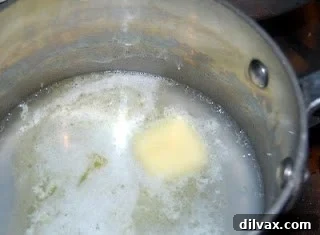
Quickly stir the cornmeal and salt and mix well.
The instruction to “quickly stir” the cornmeal and salt into the boiling liquid is key. Speed is essential here to prevent the cornmeal from clumping and to ensure it’s evenly hydrated. A wooden spoon or a sturdy whisk works best for this, rapidly combining the dry ingredients with the hot liquid until a thick, uniform paste forms. This paste is the foundation of the crisps, and its consistency will directly impact the final texture. Any lumps would result in unevenly cooked portions, detracting from the crisp’s potential. Despite the simplicity of the ingredients, this step felt surprisingly delicate, requiring a practiced hand to achieve the desired smooth mixture without overworking it.
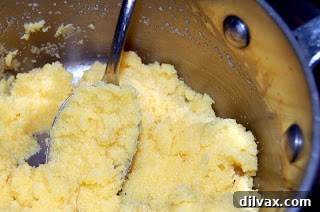
Drop by teaspoonfuls onto the cookie sheet.
Once the cornmeal mixture is prepared, it’s time to portion it onto the buttered cookie sheet. The instruction to “drop by teaspoonfuls” suggests a rustic, free-form approach, where uniformity isn’t necessarily the primary goal, but rather creating small, manageable bites. Each dollop should be spaced adequately to allow for air circulation, promoting even baking and maximum crispness. The size of the teaspoonfuls also dictates the baking time; smaller portions cook faster and crispier. This was a straightforward process, scooping and placing, each little mound holding the promise of a golden, crunchy snack.
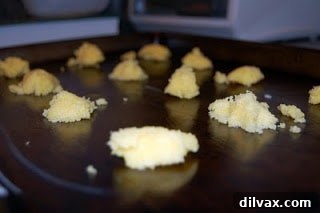
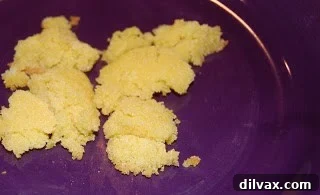
Bake for 10-15 minutes. I took them out after 10 minutes and there was a bit of smoke that accompanied them on the exit from the oven because of the buttered cookie pan.
The baking phase, typically a transformative moment in the kitchen, was concise. Ten to fifteen minutes is a short window, demanding close attention to prevent burning, especially at such a high temperature. I opted for the lower end of the baking spectrum, pulling them out at the ten-minute mark. As I opened the oven door, a plume of smoke wafted out, a clear indication that the butter I had generously applied to the cookie sheet had reached its smoke point. While it didn’t ignite, the smoke certainly added an unplanned aroma to the kitchen and the crisps themselves, a minor but memorable hiccup in an otherwise straightforward process. It served as a practical lesson in the nuances of baking temperatures and the careful application of fats.
The Verdict: A Taste Test and Honest Review of Corn Crisps
This recipe was undeniably short, quick, and to the point. From ingredient gathering to oven to cooling rack, the entire process was remarkably efficient, a testament to its simplicity. I honestly don’t think a recipe could get any easier than this. The minimal steps and basic ingredients suggest a low-effort snack, which, in theory, is highly appealing for busy individuals or spontaneous cravings. However, ease of preparation does not always equate to culinary satisfaction, and this recipe, unfortunately, proved that point rather emphatically. While the preparation was simple, the result was anything but simply delicious. It was a stark reminder that sometimes, the magic in cooking lies not just in ease, but in the harmonious balance and careful selection of flavors and textures.
Despite its swift execution, the Corn Crisps ultimately fell short of my expectations. The taste was, as I initially described, bizarre. There was an undeniable flavor of cornmeal, but without the comforting sweetness, savory depth, or satisfying chewiness typically associated with beloved cornmeal dishes like cornbread, polenta, or even crispy fried grits. These crisps were neither truly crispy nor particularly flavorful; they possessed a somewhat bland, almost pasty mouthfeel, despite their baked exterior. The pure essence of cornmeal, unadorned and unenhanced, revealed itself to be surprisingly uninspiring in this particular format. It lacked the textural complexity or flavor vibrancy that elevates a simple ingredient into something truly enjoyable.
The Fannie Farmer Cookbook lists this recipe within the “Nibbles” section of “Appetizers & First Courses,” alongside much-loved items such as popcorn and sugared nuts. This context initially suggested a light, appealing snack, perhaps a savory counterpart to the sweet offerings. However, the Corn Crisps felt significantly out of place. Popcorn offers airy crunch and customizable flavors, while sugared nuts provide satisfying sweetness and a rich, substantial bite. The crisps, by contrast, offered neither a compelling texture nor an enticing flavor profile. They simply existed, a flat, somewhat dry interpretation of cornmeal that struggled to compete with its more charismatic neighbors in the snack category.
As is customary with new recipes, I enlisted the most honest critics in my household: my children. Their reactions were immediate and unequivocal. After a hesitant bite, neither was inclined to continue, confirming my own assessment. A quick, easy snack is a household holy grail, especially for after-school munchies, but these Corn Crisps were definitely not a hit. They didn’t pass the “after-school snack” test, nor would I consider serving them to guests. The experience highlighted the importance of a compelling taste and texture, particularly when aiming to please a diverse palate. Ultimately, for this culinary experiment, the rating for these Corn Crisps is a resounding one rolling pin – a humble score signifying significant room for improvement, or perhaps, a permanent retirement from the recipe rotation.
Beyond the Bizarre: Lessons Learned from a Culinary Misadventure
Every cooking endeavor, regardless of its outcome, offers a learning opportunity. The Corn Crisps may not have been a culinary triumph, but they provided valuable insights into the nuances of taste, texture, and expectation. It’s a common experience for home cooks: not every recipe from a beloved cookbook will be a resounding success, and that’s perfectly okay. What matters is the journey of experimentation, the willingness to try new things, and the ability to learn from what works and what doesn’t. This particular misadventure served as a gentle reminder that even with simple ingredients and straightforward instructions, the magic of flavor is often in the balance, the technique, and sometimes, a little creative flair.
For those brave enough to attempt a rescue mission for this recipe, I imagine significant modifications would be necessary. Perhaps incorporating some shredded cheese or finely chopped fresh herbs like chives or rosemary could infuse much-needed flavor. A touch of garlic powder or onion powder might add a savory depth, transforming them into a more palatable cracker. Even a slight increase in butter or the addition of a binding agent like an egg could alter the texture, moving them closer to a more conventional, enjoyable crisp. This experience underscores the importance of not just following a recipe, but understanding the role of each ingredient and being prepared to adapt or enhance based on personal preference and desired outcome. It’s a call to culinary creativity, even in the face of initial disappointment.
Ultimately, this experience reinforced the notion that personal palate and preferences play a crucial role in cooking. What might have been considered a perfectly acceptable “nibble” in one era or for a particular taste, might not translate well to another. It encourages us to continue our own culinary explorations, embracing both the triumphs and the occasional “bizarre” results. Every attempt, successful or not, adds to our cooking knowledge and helps refine our understanding of what truly makes a dish delicious. So, whether your next recipe is a roaring success or a curious flop, remember to savor the experience and learn from every moment in the kitchen.
Happy baking!