Authentic Pignoli Cookies: A Sweet Journey from Rhode Island Memories to Baking Triumph
Life, much like a challenging baseball game, often throws us curveballs. Just this evening, I overheard my son in the shower, not singing, but earnestly conversing with himself. His undefeated baseball team had unexpectedly lost to a 3-3 team, and he hadn’t performed as well as he’d hoped at bat, though his defense was solid. They staged an incredible comeback from 7-1 down to lead 8-7, only to lose in the bottom of the last inning on the opponent’s field. Compounding the frustration, he sustained a minor injury in a collision at second base while catching the ball. It was one of those moments where the physical pain was undoubtedly real, but I believe the deep disappointment of the team’s performance and his personal struggle at the plate amplified that sensation. Do you know that feeling?
This is his way of processing. He talks it out, working through every detail in his head, and then he’s okay. I genuinely cherish these private moments; I also hear him doing it from his bed. He’d be mortified if he knew I was listening, catching my shadow in the hall, but I can’t help it. I’m his mother, and I know these precious, unguarded moments are fleeting. So, I listen.
In a similar vein of processing and finding comfort, there are certain joys that stay with you, etched into memory, patiently waiting to be recreated. For me, one such joy revolves around a particular Italian delicacy. During our time living in Rhode Island, our dear friends, Mary and Eddy, would often travel back to their native New York. Their return always brought with it a treasure trove of Italian goodies. On one memorable occasion, they presented us with a PINK BOX! You know my adoration for those iconic pink boxes, but it’s truly what’s inside that captures my heart. This time, nestled within, were the most divine Pignoli cookies. It was an absolute “Oh My Goodness” moment.
These cookies were utterly delicious – a perfect harmony of chewy texture on the outside, yielding to a wonderfully soft and tender interior. They literally melted in my mouth, leaving a lingering sweetness. They were so extraordinarily good that I would, or rather, beg Mary to bring them back every single time they visited New York. They represented one of those culinary masterpieces that felt almost sacred, so perfect that I was genuinely intimidated to try making them myself. I truly believed I wouldn’t be able to duplicate their exquisite taste and texture. Yes, I was, quite literally, intimidated by a cookie. For over a decade, more than twelve years, I put off the attempt. But today, that changed. Today, I baked a Pignoli cookie so remarkably close to those cherished memories that I believe even I could proudly place it into one of those beloved pink boxes! The sheer excitement was almost overwhelming.
Unlocking the Secret: The Martha Stewart Pignoli Cookie Recipe
For this delightful breakthrough, we owe a huge thank you to Martha Stewart. Her meticulously crafted recipe, found in her indispensable “Baking Handbook” on page 93, provided the perfect blueprint. The book, authored by Martha Stewart herself and published by Clarkson Potter/Publishers, a division of Random House, Inc., holds the ISBN 0-307-23672-2. It’s a testament to her expertise that such a seemingly complex cookie could be demystified.
Ingredients for Irresistible Pignoli Cookies
Creating these authentic Italian pine nut cookies requires a thoughtful selection of ingredients. Each component plays a crucial role in achieving the signature texture and flavor that makes Pignoli cookies so beloved:
- 7 ounces almond paste: This is the star ingredient, providing the rich almond flavor and fundamental structure for the cookie’s characteristic chewiness. Ensure you use quality almond paste, not marzipan, as the sugar content and texture differ.
- ½ cup granulated sugar: Contributes to the sweetness and helps with browning and texture development.
- ½ cup confectioners’ sugar, plus more for dusting: Adds fine sweetness to the dough and is essential for the traditional finishing dust, enhancing both appearance and taste.
- 2 large egg whites: Crucial for binding the dough and contributing to the chewy, meringue-like interior. Ensure they are at room temperature for better mixing.
- ½ teaspoon vanilla extract: Enhances the overall flavor profile, complementing the almond beautifully.
- 3 tablespoons all-purpose flour: A small amount of flour provides just enough structure without making the cookies tough.
- 1/8 teaspoon salt: A pinch of salt balances the sweetness and brings out the depth of the almond flavor.
- 3/4 cup pine nuts: These small, buttery nuts are not only the namesake of the cookie but also provide a delightful crunch and distinctive aroma when toasted during baking.
Step-by-Step Guide to Baking Pignoli Perfection
Follow these detailed instructions to recreate the magic of authentic Italian Pignoli cookies in your own kitchen:
Preparation is Key
Begin by preheating your oven to 350ºF (175ºC). Position your oven racks in the center and lower third to ensure even baking. Next, take two large baking sheets and line them meticulously with parchment paper. This step is non-negotiable for easy release and cleanup. Set these prepared sheets aside, ready for your cookie dough.
Crafting the Dough
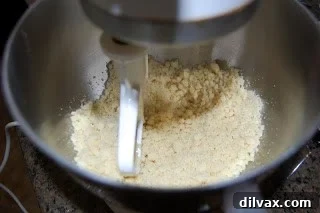
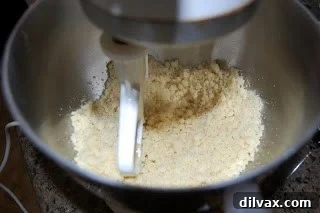
In the spacious bowl of an electric mixer, fitted with the paddle attachment, combine the almond paste with both the granulated sugar and the ½ cup of confectioners’ sugar. Beat these ingredients together on medium speed for approximately 2 minutes. The mixture will undergo a transformation, developing a coarse, crumbly texture, resembling wet sand. This initial step is vital for breaking down the almond paste and evenly distributing the sugars.
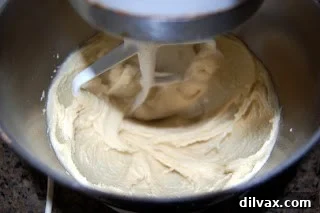
Next, introduce the two large egg whites and the ½ teaspoon of vanilla extract to the mixture. Increase the mixer speed to medium-high and continue beating for 3 to 4 minutes. During this time, the crumbly mixture will gradually coalesce, transforming into a smooth, cohesive paste. It should be thick and glossy, indicating that the egg whites have properly emulsified with the almond and sugar base. This consistency is crucial for the cookie’s final texture.
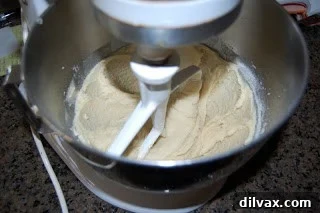
Finally, add the 3 tablespoons of all-purpose flour and the 1/8 teaspoon of salt. Beat on low speed until these dry ingredients are just combined, which should take about 1 minute. Be careful not to overmix at this stage. The resulting dough will be notably soft and quite tacky to the touch. This stickiness is characteristic of Pignoli dough and is perfectly normal.
The Pine Nut Coating
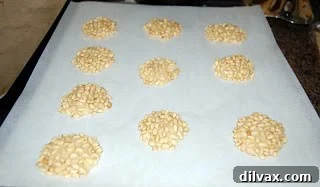
Place the ¾ cup of pine nuts in a small, shallow bowl, ready for coating. Now, scoop out approximately one tablespoon of the prepared dough. Here’s a pro tip for handling the sticky dough: slightly dampen your fingers with water. This will prevent the dough from adhering excessively to your hands. Gently drop the dough portion into the bowl of pine nuts, ensuring one side of the dough ball is generously coated. Carefully transfer these dough rounds, pine nut-coated side facing up, onto your prepared baking sheets. Make sure to space them about 2 inches apart to allow for spread during baking. Repeat this process with the remaining dough. If any of your rounds have bare spots, simply press a few extra pine nuts onto those areas to ensure full coverage.
Baking to Golden Perfection
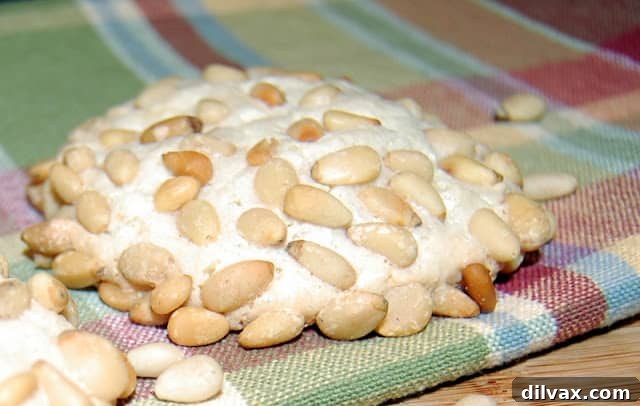
Place your baking sheets into the preheated oven. Bake the cookies for 13 to 15 minutes, making sure to rotate the sheets halfway through the baking time. This ensures even heat distribution and consistent browning. The cookies are done when their edges and the pine nuts have turned a beautiful golden brown. The centers should still be soft, but the exterior should offer a slight resistance. Once baked, carefully transfer the cookies, still on their parchment paper, to a wire rack. Allow them to cool completely. This step is crucial; attempting to move them too soon can result in breakage. Once cool, use an offset spatula to carefully loosen each cookie from the parchment paper.
The Finishing Touch and Storage
For a traditional presentation and an extra touch of sweetness, use a fine sieve to lightly dust the cooled cookies with additional confectioners’ sugar. If you’re not planning to devour them all immediately, Pignoli cookies can be stored beautifully. Simply stack them between layers of waxed or parchment paper in an airtight container. They will maintain their exquisite freshness and texture at room temperature for up to 4 days.
Beyond the Recipe: Expert Tips for Your Best Pignoli Cookies Ever
While the recipe itself is straightforward, a few insights gained from experience can elevate your Pignoli cookie game:
Handling Sticky Dough
The dough is notoriously sticky, as noted. My initial approach with dampened fingers worked, but next time, I’d consider lightly dusting my hands with confectioners’ sugar or even a touch of flour before handling the dough for an even smoother experience. Alternatively, using two spoons to scoop and drop the dough into the pine nuts can also be effective, helping to maintain a more uniform shape without direct contact. I found a larger tablespoon useful for transferring them from the pine nuts to the parchment, which helped create more rounded shapes, and then I just removed any excess pine nuts by hand.
Optimizing Cookie Size and Baking Time
The recipe suggests scooping by tablespoonfuls, which resulted in about 23 cookies for me, slightly more than the estimated 18. However, I personally found the final cookies a bit too large. Next time, I plan to use a teaspoon instead of a tablespoon. This will yield smaller, more delicate cookies and will necessitate a slight reduction in baking time. Smaller cookies might bake in 10-12 minutes, so keep a close eye on them to prevent over-browning. My preference would be to have two perfectly sized cookies for every larger one I made this time.
The Confectioners’ Sugar Dusting
In my excitement, I completely forgot to dust the finished cookies with confectioners’ sugar. And honestly? They didn’t even need it. They were so utterly yummy and delicious on their own. However, for that classic bakery aesthetic and a whisper of extra sweetness, I do recommend the dusting. It truly adds to the visual appeal.
Pine Nut Quality Matters
The quality of your pine nuts can significantly impact the final flavor. Opt for fresh, plump pine nuts. Some bakers even lightly toast their pine nuts before coating for an intensified flavor, though it’s not strictly necessary for this recipe, as they will toast beautifully in the oven.
The Unforgettable Taste: A Personal Review
My Pignoli cookies truly lived up to the “Oh My Goodness” standard. The aroma filling my kitchen was intoxicating, and the first bite transported me straight back to those Rhode Island memories. My husband, usually reserved in his praise for my baking endeavors, was utterly amazed at how good they were. In fact, he declared them, to date, the absolute best thing I have ever baked.
“Better than the crème brûlée?” I asked, a hint of challenge in my voice, knowing his deep affection for that particular dessert.
He paused, considered it deeply, and then, with conviction, replied, “Yeah, even better than the crème brûlée.”
Now, that truly is saying something, considering he had previously lauded the crème brûlée as “pretty darned good.” I might just be spoiling him, but oh, the joy of creating something that elicits such a strong, positive reaction is priceless.
My Verdict: Four Rolling Pins!
My personal rating system is based on a scale of 1 to 4, with 4 representing the absolute pinnacle of culinary achievement. I’m quite certain you already anticipate the rating for these Pignoli cookies: a resounding 4 rolling pins! Yes, they were unequivocally *that* good. I cannot recommend them highly enough. Don’t hesitate; don your Italian apron, gather your ingredients, and embark on this baking adventure. I am confident you will not regret it. These Pignoli cookies are more than just a sweet treat; they’re a taste of tradition, a triumph over baking intimidation, and a pure moment of joy.
Happy baking!