Baking Bliss: Crafting Festive Green & White Layered St. Patrick’s Day Cupcakes
Every holiday offers a unique opportunity to infuse a little extra joy and color into our lives, and St. Patrick’s Day is no exception. With its vibrant hues of green, it’s the perfect occasion to get creative in the kitchen. Recently, my daughter was invited to a St. Patrick’s Day party and needed to bring a green-themed treat to share. My mind immediately jumped to cupcakes – those delightful, individual portions of happiness just begging for a festive makeover. I envisioned something spectacular: perfectly layered green and white cakes, each slice revealing a striking pattern, topped with a cloud of delicious, fluffy frosting, elegantly swirled into a masterpiece. In my head, these wouldn’t just be cupcakes; they’d be a culinary triumph.
However, as my husband often reminds me, approaching any endeavor, especially our children’s athletic pursuits, with zero expectations can save a lot of emotional attachment and potential disappointment. It’s a philosophy he applies to baseball games and, I suppose, it holds true for baking as well. Yet, after watching countless episodes of ‘Cupcake Wars’ and ‘DC Cupcakes,’ where master bakers consistently produce visually stunning and impeccably flavored treats, it’s hard not to dream big. They make it look so effortless, almost as if perfection is attainable on the very first try. While I know they are professionals who dedicate their lives to this craft, a small part of me always wonders, “Why can’t I achieve that level of flawless execution right away?” It feels like a reasonable aspiration, doesn’t it?
The Quest for the Perfect Recipe: Drawing Inspiration from Culinary Classics
To embark on this green and white cupcake adventure, I turned to my trusted collection of cookbooks. I decided to adapt recipes from two culinary staples, hoping to combine their strengths for the ultimate festive treat. The foundation for the delicate cupcake batter was discovered in The New Doubleday Cookbook, specifically on page 802. This comprehensive guide, authored by Jean Anderson and Elaine Hanna and published by Doubleday (a division of Random House, Inc.), provided a reliable starting point for a classic white cake. Its ISBN is 0-385-19577-X, a testament to its enduring legacy in many home kitchens.
For the frosting, I sought a recipe that promised a light and airy texture, and my search led me to The Fannie Farmer Cookbook, Thirteenth Edition. On page 602, authored by Marion Cunningham and published by Alfred A. Knopf, Inc. (also a division of Random House, Inc.), I found a promising candidate. The ISBN for this edition is 0-394-56788-9. These timeless resources often hold the keys to fundamental techniques and flavors, providing a sturdy backbone for any baking experiment. While I often enjoy putting my own spin on things, starting with a well-established recipe is crucial for understanding the basic principles before venturing into creative adaptations – a lesson I would soon learn with the frosting!
Crafting the Canvas: Basic Green & White Layered Cupcakes
These cupcakes are designed to be a visual delight, featuring distinct layers of white and vibrant green cake. The layering technique, while adding a touch of sophistication, is surprisingly straightforward and creates a wonderful surprise when the cupcakes are cut open. This recipe yields approximately 18 standard-sized cupcakes, perfect for sharing at a festive gathering.
Ingredients for Basic White Cupcakes:
- 2½ cups sifted cake flour
- 1 tablespoon baking powder
- ½ teaspoon salt
- ⅔ cup unsalted butter, softened
- 1½ cups granulated sugar
- 1 teaspoon vanilla extract
- ¾ cup whole milk, at room temperature
- 4 large egg whites, at room temperature
- Green gel food coloring (gel works best for vibrant color without altering batter consistency)
- Paper muffin cups or liners
Instructions for Layered Cupcakes:
- Prepare Your Workspace: Preheat your oven to 375ºF (190ºC). Line an 18-cup muffin tin with paper liners. Ensuring your ingredients are at room temperature is a critical step for a smooth, well-emulsified batter.
- Sift Dry Ingredients: In a medium bowl, sift together the cake flour, baking powder, and salt. Sifting helps to aerate the flour, preventing lumps and resulting in a lighter, more tender crumb. Set this mixture aside.
- Cream Butter and Sugar: In a large mixing bowl, cream the softened butter until it’s light and fluffy. Gradually add 1¼ cups of the granulated sugar, continuing to cream the mixture until it’s pale in color and very fluffy. This process incorporates air, which is essential for the cupcakes’ texture.
- Add Vanilla: Stir in the vanilla extract until just combined.
- Alternate Wet and Dry: With your mixer on a low speed, gradually add the dry ingredients alternately with the milk. Begin and end with the dry ingredients, adding about one-third of the total dry mixture at a time, followed by half of the milk. Mix only until just combined after each addition to avoid overmixing, which can lead to tough cupcakes.
- Prepare Egg Whites: In a separate, clean bowl, beat the 4 egg whites until they are frothy. Slowly add the remaining ¼ cup of sugar (from the 1½ cups total) and continue beating until the egg whites form very soft, glossy peaks. Do not overbeat to stiff peaks, as this can make them difficult to fold in.
- Fold in Egg Whites: Gently fold the beaten egg whites into the cupcake batter just until no streaks remain. This step adds extra air and lightness to the batter.
- Divide and Color the Batter: Divide the batter into two separate bowls. Spoon approximately one-third of the batter into a smaller bowl. To this smaller portion, add 5-10 drops of green gel food coloring, depending on your desired shade. Mix gently until the color is uniform. For a deeper, more vibrant green, add additional drops two at a time, mixing thoroughly after each addition.
- Layering Technique:
- Drop one level tablespoonful of the plain white batter into the bottom of each prepared muffin cup. Use a small offset spatula or the back of a spoon to gently smooth the batter flat.
- Carefully drop one level tablespoonful of the green batter on top of the white layer. Be very gentle to avoid mixing the two colors. Smooth the green layer flat with a separate, clean knife or spatula.
- Finally, gently drop one level tablespoonful of the remaining white batter on top of the green layer. Smooth this final white layer flat. Each muffin cup should be approximately ¾ full.
- Bake: Place the muffin tin in the preheated oven and bake for 20-25 minutes. The cupcakes are done when the tops are lightly golden brown, and a toothpick inserted into the center comes out clean.
- Cool Completely: Remove the cupcakes from the oven and let them cool in the muffin tin for a few minutes before transferring them to a wire rack to cool completely. It’s absolutely crucial that the cupcakes are entirely cool before frosting to prevent the frosting from melting.
Tip for even layers: Use measuring spoons for consistent amounts in each layer. For a more pronounced marbled effect, you can swirl the layers slightly with a toothpick, but for distinct layers, avoid mixing.
 |
| Achieving distinct layers: White batter on top of green, ready for baking. |
The Sweet Topping: Seven Minute Peppermint Frosting – A Journey of Expectations and Adaptations
A truly festive cupcake deserves an equally delightful frosting. For these St. Patrick’s Day treats, I envisioned a light, airy, and refreshing peppermint frosting. The “Seven Minute Frosting” from my Fannie Farmer Cookbook seemed like the perfect candidate – a classic meringue-based frosting known for its fluffy texture. However, as any home baker knows, even the most tried-and-true recipes can present challenges, especially when one decides to introduce “creative adaptations.”
A note to the adventurous baker: The recipe below is the exact one from the cookbook. My personal modifications (which I recount in detail afterwards) did not yield the desired results. For a successful outcome, I strongly advise following this classic recipe precisely, or consider a more forgiving alternative.
Ingredients for Seven Minute Peppermint Frosting:
- 1½ cups granulated sugar
- ¼ teaspoon cream of tartar
- ⅛ teaspoon salt
- 2 large egg whites
- ¼ cup water
- ½ teaspoon peppermint extract
Instructions for Seven Minute Peppermint Frosting (The Correct Way):
- Set Up Double Boiler: In a heatproof bowl (metal or glass) that fits snugly over a saucepan containing about an inch of simmering water, combine the sugar, cream of tartar, salt, egg whites, and ¼ cup of water. Ensure the bottom of the bowl does not touch the simmering water.
- Beat Over Heat: Begin beating the mixture steadily with a rotary or electric hand beater over low heat. Continue beating for approximately 5-7 minutes. The goal is for the frosting to become thick, white, and stand in soft peaks. It’s crucial not to beat for longer than this timeframe over the heat, as the meringue can become grainy.
- Remove and Continue Beating: Remove the bowl from the heat. Continue beating the frosting until it becomes thick enough to hold its shape and spreadable. This could take another 3-5 minutes.
- Add Flavoring: Once the frosting has reached the desired consistency and has cooled slightly, beat in the peppermint extract until well combined.
- Frost Immediately: Use the frosting immediately to decorate your completely cooled cupcakes. This type of frosting sets quickly, so swift application is key.
 |
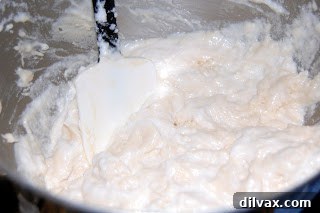
| A glimpse into my initial, ill-fated frosting attempt with white chocolate morsels. |
My Frosting Fiasco: Lessons Learned (The Hard Way!)
Ah, the best-laid plans of bakers! My vision for this frosting extended beyond mere peppermint. I yearned for a peppermint white chocolate frosting – a seemingly divine combination. This is where my “adaptations” began, and where the story takes a turn. My first misstep was adding a full cup of white chocolate morsels directly into the pan with the other ingredients over the heat. My second, and perhaps more critical, error was realizing I had run out of sugar and decided to omit ½ cup from the original recipe. In my defense, I reasoned that the white chocolate chips would add sweetness, negating the need for the full amount of sugar. Oh, how wrong I was!
The result? A frustrating mess. After 5 minutes over the simmering water, instead of thickening and forming peaks, my “frosting” remained stubbornly runny. It was nowhere near the dreamy consistency I’d envisioned. Panic began to set in. Do I add powdered sugar? Flour? Cornstarch? I desperately searched my baking knowledge for a quick fix. Powdered sugar seemed the most logical choice for thickening, but I was hesitant to add more sweetness, and I worried about that distinct powdered sugary taste altering the delicate peppermint flavor. As for flour or cornstarch, I couldn’t recall seeing them in any frosting recipes, so that felt like a risky venture.
In a moment of combined desperation and pragmatism (or perhaps sheer folly!), I reached for the ultimate shortcut: a whole container of store-bought Betty Crocker White Whipped Frosting! “Woo hoo!” I might have exclaimed, though as a New Englander, my “woo hoo” was layered with a thick coating of sarcasm. Did it “fix” it? Not entirely. While the canned frosting did manage to make my runny concoction a little less liquid, it certainly didn’t transform it into the fluffy, peak-forming meringue I had initially set out to create. My frosting adaptation earned its place in the growing list of my “365-day baking challenge mishaps.”
It’s often said that we learn from our mistakes, and while I certainly learned what not to do, I’m still a bit disappointed that this particular blunder didn’t teach me a magical trick to salvage a failed Seven Minute Frosting. As you can observe from the accompanying picture, the final frosting ended up quite flat on top of the cupcakes. C’est la vie! Despite its aesthetic shortcomings, I must admit, it still tasted surprisingly good – the peppermint shone through beautifully, perhaps even more prominently than if the white chocolate had fully cooperated. So, learn from my experience: sometimes, the classic recipe is truly the best path to success. Or, if all else fails, a can of ready-made frosting is a forgiving friend!
The Verdict: A Sweet Ending (Despite the Bumps!)
Ultimately, these St. Patrick’s Day cupcakes were a journey of both triumph and tribulation. The interior of the cupcakes, with their charming green and white layers, were cool and unique, even if they didn’t quite match the idealized image in my head. I suppose I am my own harshest critic and, admittedly, a bit of a perfectionist when it comes to baking. However, the most important judges – my kids – loved them! The feedback from my daughter’s party was overwhelmingly positive, which is truly what matters most.
Baking, much like life, is a process. It takes practice, patience, and a willingness to embrace the imperfections along the way. Each attempt, whether a resounding success or a minor mishap, is an opportunity to learn and refine one’s skills. I’ll get there, one cupcake at a time.
In my personal rating system, which ranges from 1 (meh) to 4 (knock-your-socks-off delicious), these St. Patrick’s Day cupcakes, despite the flat frosting incident, earned a respectable 3 rolling pin rating. The flavor profile – a delightful balance of cake and a pronounced peppermint kick – was genuinely delicious, proving that taste can often outweigh visual perfection. So, take my advice: stick to the classic Seven Minute Frosting recipe as I’ve laid it out, or if you’re truly short on time or patience, there’s absolutely no shame in reaching for a quality canned frosting. The goal is always to enjoy the process and the delicious outcome!
Happy baking, and may your kitchen adventures be filled with joy and delicious discoveries!